

A partnership that delivers impact
When Kim Hodgkinson moved into her bungalow in a quiet neighbourhood in Colchester, Nova Scotia, it had everything she needed: it was close to her three daughters’ school, five minutes from her work and close to her parents. What the house didn’t offer, however, was reliable warmth. It was heated with oil, which Hodgkinson didn’t like, as well as a nearly defunct heat pump. The older doors, which didn’t close properly, made the place drafty. “I just didn’t have the funds to keep heating this place. So I had to figure something out.”
As a single mother on a fixed budget, Hodgkinson was daunted by the cost of making the necessary upgrades. Then, while listening to the radio, she heard an ad for a municipal program that would allow her to finance the upgrades, with repayments made directly to the municipality. “I thought ‘I’m just going to check it out. You never know.’ And so, I checked it out and . . . it was almost too good to be true.”
Cozy Colchester, as the program was known, is a product of a deceptively simple idea: by removing the upfront costs preventing homeowners from getting off wood and oil and making efficiency upgrades to their homes, municipalities could improve affordability while reducing greenhouse gas emissions and cutting down on energy use.
The model underlying the program is known as property assessed clean energy (PACE) financing. PACE programs finance efficiency retrofits that otherwise might feel unaffordable, through loans that are secured to the property. One survey of program participants in Toronto found that nearly 80% would not have undertaken retrofits without this kind of program. Increasingly, Canadian municipalities are using them to support homeowners in making efficiency upgrades, while also creating delivery capacity for that work, by ensuring a pipeline of projects that contractors can rely on.
In 2020, leveraging a $300-million investment from the federal government, the Federation of Canadian Municipalities’ Green Municipal Fund (GMF) launched its Community Efficiency Financing initiative to help communities offer retrofit financing programs, using innovative financing models like PACE. Cozy Colchester was one of the first programs supported. Prior to the initiative, only a handful of PACE programs were active across the country. Building on two decades as a proven federal–municipal delivery platform, GMF moved quickly and efficiently to scale the Community Efficiency Financing initiative, and today there are more than 40 PACE programs in eight provinces, with an anticipated 16,000 homes retrofitted, 3,800 jobs created and $380 million added to the country’s gross domestic product.
Carole Saab, CEO of the Federation of Canadian Municipalities, says that local programs like these are the key to a larger market transformation. “Strong communities are the foundation of a strong economy. PACE works because it removes one of the biggest barriers to home-energy upgrades, upfront costs, while giving municipalities a practical way to deliver at scale.”
Catalyzing scale for home retrofits
In Canada, buildings are a major source of emissions, with roughly 18% of the country’s emissions produced through lighting, heating and cooling structures. But upgrading those buildings to cut emissions and energy costs can require substantial upfront investment. In its national electricity strategy published in May, the federal government pledged to take action on energy-saving retrofits for up to one million households. Through its early investment in GMF’s Community Efficiency Financing, Ottawa has already demonstrated that solutions to meet this objective exist and that by continuing to scale, initiatives like this bring the goal within reach.
The biggest barrier to home retrofits is the upfront cost. Cozy Colchester and other PACE programs allow property owners to obtain project financing and overcome the high upfront costs of retrofits by paying it back over a long period. That means long-term savings on energy bills and lower monthly repayments. Because the loans are tied to the property and paid back directly to the municipality or on the property tax bill, the rate of default is extremely low – qualities that make these programs attractive to investors. The numbers tell the story: thousands of home upgrades that would have been otherwise out of reach of homeowners and $70 million in commitments from private lenders, making public funds stretch further.
Those qualities also made PACE the right fit for the Municipality of Colchester, where the program not only funds solar installation and green energy retrofits, but also provides support in the form of energy consultants and vetted contractors.
“These are big projects that most homeowners don’t have the capacity to pay for out of pocket,” says Joanna Burris, sustainability planner for the Municipality of Colchester. For Christina Lycan, that support was essential. Lycan and her family moved to a rural part of Colchester County during the pandemic, seeking more space. Through Cozy Colchester, the family was able to swap the home’s oil furnace for heat pumps and add an electric hot water heater; they also installed solar panels and a backup battery system. “We have the heating and cooling from the heat pumps all year long, so that makes a huge difference,” Lycan says. Even better, with their battery system and solar panels, their electricity bills are negligible.
Colchester isn’t the only PACE pioneer in Nova Scotia. In 2013, Halifax Regional Municipality launched Solar City, Canada’s first PACE program. The program has provided more than $27 million in financing for solar installations, helping residents cut energy costs while supporting the growth of the local solar industry. Similar models have since spread across Canada, including Kingston’s Better Homes Kingston program, Guelph’s Greener Homes program, and Saskatoon’s Home Energy Loan Program, as well as municipal programs across Alberta.
Local impact, national prosperity
The benefits aren’t restricted to homeowners. Community Efficiency Financing–funded programs are expected to create more than 3,800 local jobs and contribute an estimated $380 million to Canada’s GDP. Alberta’s Clean Energy Improvement Program, for instance, has helped build a network of more than 500 skilled workers to deliver projects. Crucially, such programs create a steadier pipeline of work, helping to smooth boom-and-bust cycles in the retrofit market. Justin Smale, who manages Calgary’s Clean Energy Improvement Program, says the model improves affordability while “injecting money into the local economy that we would not have seen without this program.”
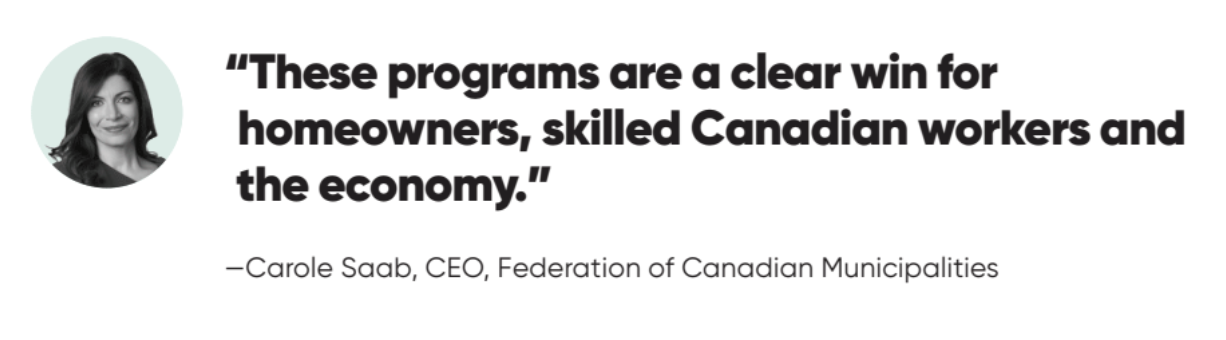
“These programs are a clear win for homeowners, skilled Canadian workers and the economy,” Saab says. “With the right conditions, we can build on that success and scale from energy efficiency into home resilience and, over time, commercial and multi-residential buildings.”
Protecting people and homes from severe weather
With millions of properties still in need of retrofitting, there’s ample room for PACE programs to scale up. But with floods, heat waves and other climate impacts accelerating, there’s also an opportunity for these programs to help Canadians protect their homes from extreme weather.
Just as energy-efficiency financing is meant to make it easier for homeowners to install measures to reduce their energy use and emissions, residential resilience financing can help protect against wildfires, floods and extreme weather. With support from GMF, Canadian municipalities are now investigating how PACE programs can help homeowners make investments in increased resilience – which could include measures like HVAC air purifiers, backup battery power and water-resistant basement materials – alongside existing PACE efficiency programs.
Saab says the Federation of Canadian Municipalities is expanding on the success of PACE through its Residential Resilience Financing offer. “Our aim is to build on what this federal–municipal partnership has already demonstrated through home-energy retrofits: that we can move quickly, prove practical solutions locally and scale what works.”
Expanding PACE financing to resilience upgrades creates a stable, scalable investment opportunity, just as the model has already generated for efficiency retrofits. Additionally, by working with insurers, residential resilience programs can support insurability and safeguard long-term property values, even as climate disasters increase.
Christina Lycan sees the potential. While financing from Cozy Colchester allowed her to lower her power bill and increase her home’s comfort, the original impetus came from her experience with Hurricane Fiona in 2022 – the most costly extreme-weather event in Atlantic Canadian history, with $800 million in damages. After the storm, she and her family lost power for almost a week, and because they were on a well, that left them without water. With a two-week-old baby at home, they were forced to decamp to her parents’ place in New Brunswick. “After that, I said ‘Never again.’”
With her backup battery system, that’s changed. In December, a severe storm knocked out power to the neighbourhood for 48 hours, but in Lycan’s home, the family had lights, heat and, crucially, flushable toilets. “If we lost power right now, I would never know.”
Lycan’s story demonstrates that with the proper support, homeowners are ready to make the right choices – for themselves, for their communities and, ultimately, for the planet. In towns and cities across Canada, GMF’s ongoing impact as a federal–municipal delivery platform is making those solutions easier for cities to offer homeowners at scale across the country.
Twenty-six years ago, in partnership with the Federation of Canadian Municipalities, the federal government created the Green Municipal Fund as a mechanism to transform communities through sustainable infrastructure. With seed funding that comes from the interest from its stable endowment along with interest and repayments from municipal loans, GMF plays a crucial role in finding climate solutions, proving they work and bringing them to scale.
Learn more: greenmunicipalfund.ca/invest
The Weekly Roundup
Get all our stories in one place, every Wednesday at noon EST.
The post A partnership that delivers impact appeared first on Corporate Knights.